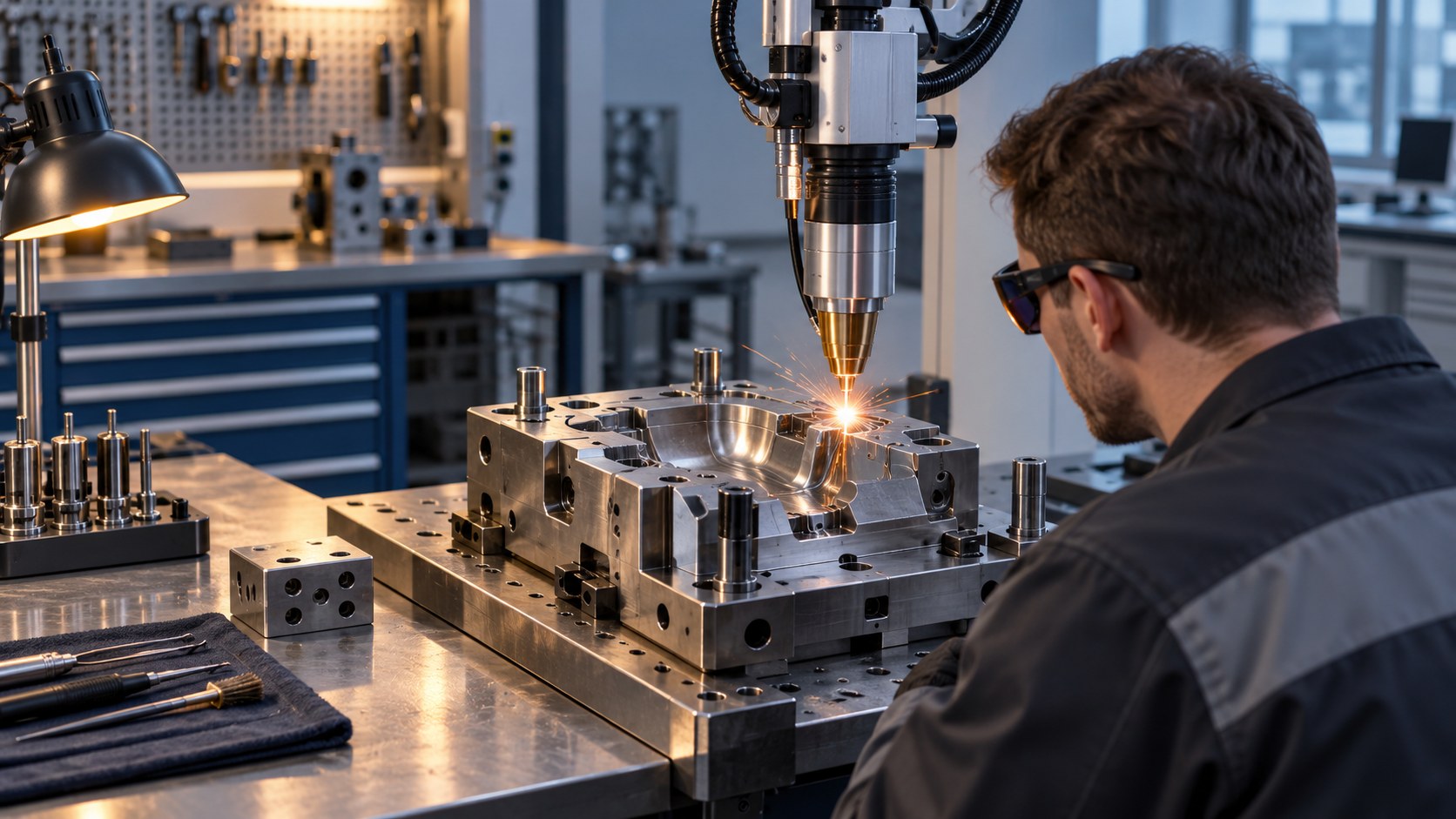
When an injection mold needs a local correction, replacing the entire mold is not always the first option. Wear, machining errors, electrical discharge machining (EDM) marks and design changes can leave defects that require material to be added at a specific location and then machined again. A mold laser welding machine gives the repair team a way to carry out that localized build-up work under controlled conditions.
The value of laser welding in this setting lies in a defined repair process. The work station can be organized around the damaged area: inspect the defect, clean the surface, add welding wire where required, and then machine or polish the repair to the specified dimensions and finish. Mold repair becomes a process that can be documented, inspected and reviewed, rather than simply a request to weld the area again.
BOGONG’s mold laser welding equipment is intended for injection-mold repair, plastic-mold components, wear restoration and build-up welding for mold modifications. The product information lists BG-200, BG-300 and BG-400 as catalog models. The final selection still depends on the mold material, repair depth, weld location, welding wire and subsequent surface requirements.
Before purchasing, prepare a repair checklist covering the materials commonly handled, defect types, typical repair depths, wire diameters, requirements for parting lines and textured surfaces, and the intended machining after welding. Also review the operator’s working position, training needs, fume extraction and access to the repair area.
Laser welding does not replace inspection or final machining. It is a tool for localized material addition, and the result depends on preparation, process settings and the work performed afterward. For a mold shop, trials on real molds are generally more useful for selection than a comparison of brochure specifications alone.
First establish whether the defect is suitable for laser repair welding
Not every mold problem should go straight to the welding station. Group the work into wear, chipped corners, insufficient machining allowance, EDM marks and design modifications. Then record whether each defect is close to a parting line, a sharp corner, a textured area or a thin wall. This makes the repair conditions visible before a machine is selected.
Mold laser welding is particularly relevant when a local area needs added material followed by machining or polishing. Recording the defect category makes it possible to compare welding wires, pulse settings and finishing methods on similar jobs. The comparison should remain tied to the actual mold and its final function.
Assess both dimensions and surface condition
A repair should not be accepted on the basis of weld color alone. Check the dimensional allowance in the repaired area, the shape of edges and corners, machining marks after welding, and the final texture. If the mold is returning to production, record the critical dimensions and appearance of the first molded trial part as well.
These records turn an individual repair into useful process information for future work. They also give BOGONG a clearer basis for discussing equipment configurations for similar molds, without treating one successful sample as proof that every material and defect will behave in the same way.
Provide a complete brief for a mold laser welding quotation
Send the mold material, defect photographs, repair depth, welding-wire grade, texture that must be preserved, maximum workpiece size and planned machining after welding. BOGONG, a manufacturer based in Qingdao, can use this information to discuss machine configuration, sample trials and an FOB quotation range. Catalog reference specifications must still be confirmed in the final technical documents.
Questions to ask before choosing a supplier
How should I compare mold laser welding machine manufacturers?
Start with whether a supplier can evaluate a sample using your mold material, defect photographs and required repair depth. Buyers often know the defect they need to repair but have not yet decided on welding wire, pulse settings or the work-station arrangement. A power rating alone does not resolve those choices. Use drawings and samples to discuss the configuration, training, machining after welding and FOB quotation with BOGONG.
What acceptance records are needed for precision mold welding equipment?
Record dimensions before welding, the allowance left by the added material, machining after welding, restoration of the texture, and the first mold-trial results. These checks give the purchase of precision mold welding equipment a verifiable repair process and a defined outcome.
Discuss your mold repair application
Review the BOGONG Mold Laser Welding Machine, then send the mold material, defect photographs, repair depth and required finish. These details provide a practical starting point for configuration discussions and sample-testing recommendations.
Need a machine recommendation?
Send your workpiece drawings, material type, burr condition and target surface finish. We will suggest the right sanding machine and give you an FOB price range.