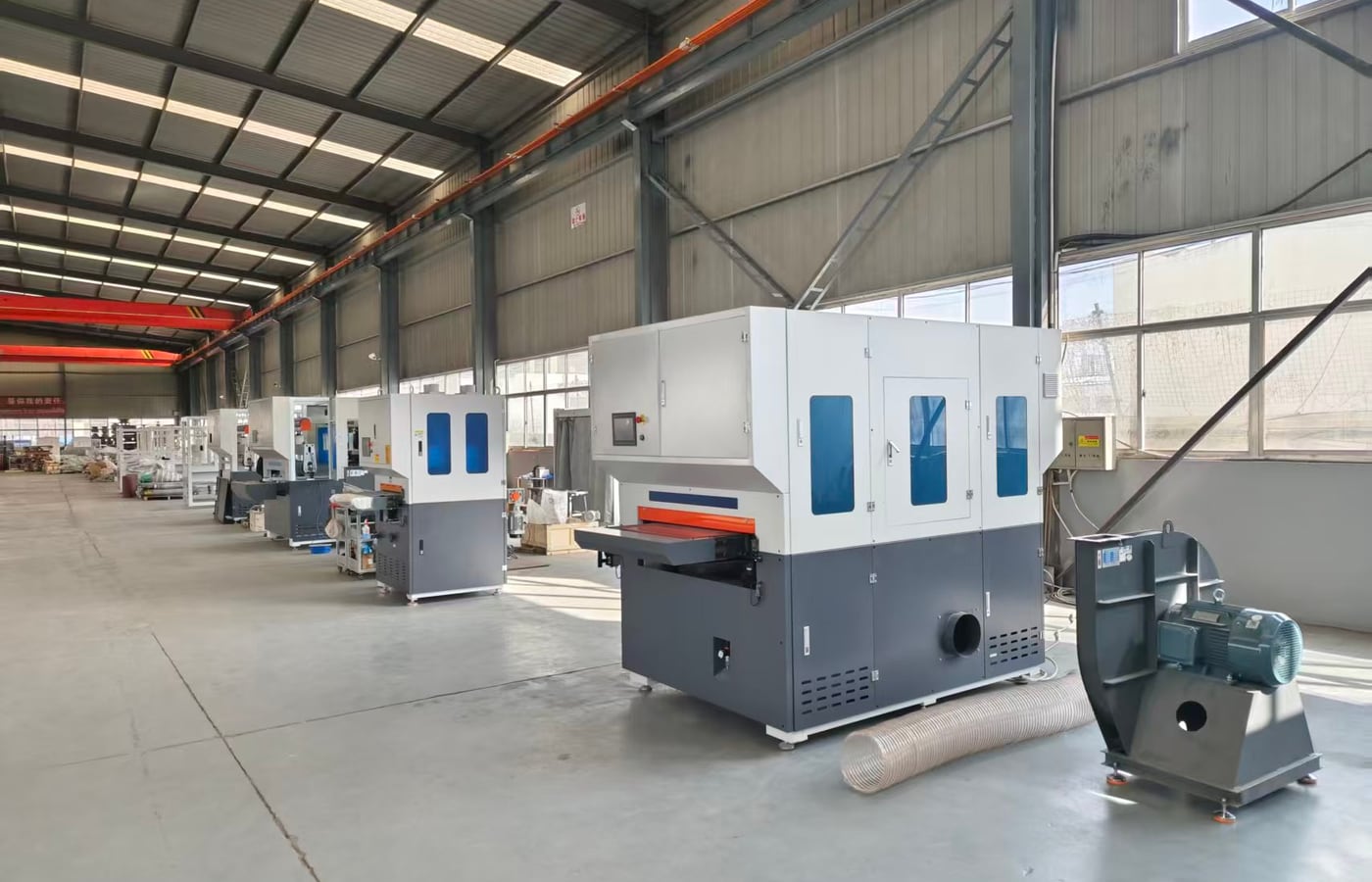
Overview
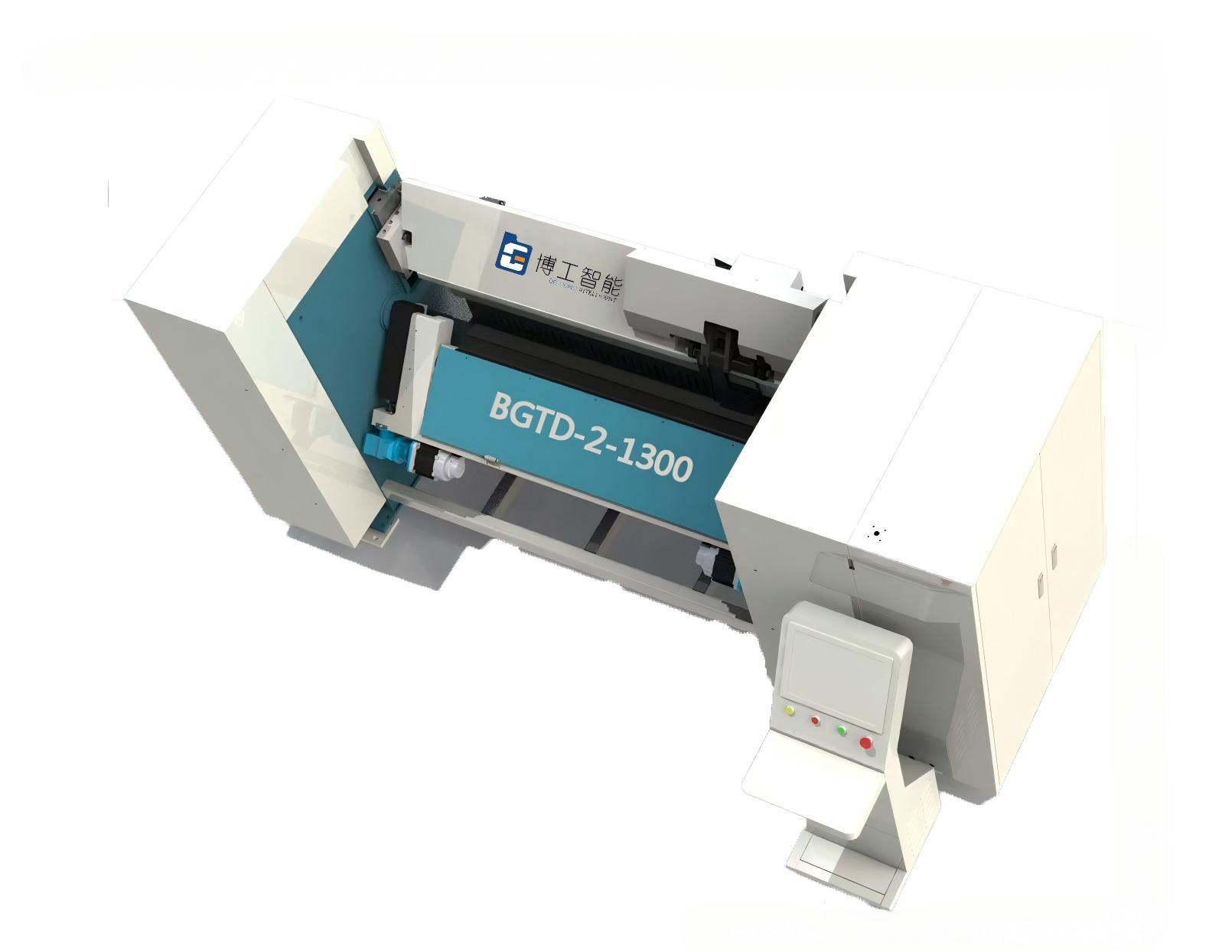
The BG-FM-1000 Metal Finishing Machine is a factory-direct, pass-through sanding and brushing unit engineered for sheet-metal workshops that run regular laser-cutting batches. It integrates three surface-processing steps—edge deburring, flat grinding, and directional brushing—into a single automatic workflow. With a 1000 mm working width and variable-frequency drive, the BG-FM-1000 delivers uniform surface quality across carbon steel, stainless steel, and aluminum plates while cutting manual grinding hours by up to 80 %.
Designed at our Qingdao production base, every unit is CE-marked and ISO-compliant. We keep MOQ at one set so you can place a trial order, verify finish quality on your actual parts, and scale up without locking capital into bulk purchases.
How It Works
The operator feeds laser-cut sheets onto the motorized in-feed conveyor. A set of contact rollers and oscillating abrasive belts remove burrs and slag from cut edges while simultaneously dressing the top and bottom faces. A secondary brush head lays down a consistent No. 4 satin or hairline finish, depending on the belt/grit configuration you choose.
Variable conveyor speed (3–15 m/min) lets you trade off between stock removal and surface gloss. Thicker plates or heavier burrs simply slow the belt; delicate cosmetic parts speed it up. The entire cycle is hands-free after loading, freeing operators for welding, bending, or QC tasks.
Key Advantages
1. Three-in-One Process Integration
Instead of moving parts from a pedestal grinder to a wire-wheel station and then a brushing table, the BG-FM-1000 completes all three stages in one pass. This reduces WIP inventory, shrinks floor-space requirements, and eliminates cross-contamination between process steps.
2. Consistent Finish, Batch After Batch
Manual sanding introduces human variation—some operators grind too aggressively and thin the edge, others miss burrs entirely. The machine’s fixed abrasive geometry and constant roller pressure guarantee every panel exits with the same Ra value and scratch pattern, which is critical when you supply visible architectural panels or appliance skins.
3. Wide Material Compatibility
Quick-change abrasive belts and brush media let you switch from carbon steel to stainless steel or aluminum in under 10 minutes. You do not need a dedicated line for each alloy, so small-batch, high-mix fabricators can stay agile.
4. Matched Dust Collection (Optional)
Grinding steel and aluminum creates combustible dust. We offer a bolt-on cartridge dust collector rated for the BG-FM-1000’s airflow. The collector is shipped pre-piped; installation takes two hours. If your plant already has central extraction, we can supply an adapter flange instead.
5. Low Running Cost
Abrasive belts are standard industrial sizes available locally in most countries. There are no proprietary consumables, no software licenses, and no dealer-locked spare-parts catalog. When a belt wears out, you buy the same 1000§×2000 mm specification from your preferred supplier.
6. Compact Footprint
At roughly 2.2 m × 1.4 m × 1.6 m (L×W×H), the BG-FM-1000 fits into existing workshop layouts without requiring structural modifications or reinforced floors. Its castor base allows you to roll it away when you need floor space for large weldments.
Typical Applications
- Laser-cut sheet deburring – Remove dross and micro-burrs from CO₂ and fiber laser cuts before powder coating or electroplating.
- Stainless steel hairline finishing – Produce consistent No. 4 directional grain on elevator panels, kitchen equipment, and pharmaceutical tables.
- Aluminum plate pre-finishing – Prepare anodizing-quality surfaces by removing oxide streaks and minor scratches from sheared or laser-cut blanks.
- Post-weld cleaning – Blend TIG weld beads into surrounding parent metal so the joint disappears under paint or chrome.
- Batch production of chassis and enclosures – Process multiple small panels on the same belt; uniform finish simplifies later assembly and inspection.
Optional Configurations
| Option | Description | When to Choose |
|---|---|---|
| Wet grinding kit | Closed coolant loop with filtration | Aluminum or titanium; explosive-dust control |
| Magnetic conveyor bed | Powerful permanent-magnet table | Small ferrous parts that slide on standard rollers |
| Out-feed stacking table | 500 mm roller table with side guides | High-volume runs; reduces operator fatigue |
| Additional brush head | Second oscillating brush station | Mirror-preparation or double-sided grain |
| Dust collector | 2.2 kW cartridge collector, 99.5 % efficiency | Indoor workshops without central extraction |
Maintenance & Support
Daily maintenance is limited to clearing the dust tray, checking belt tracking, and inspecting conveyor rollers for embedded chips. Belt change-over takes one operator about five minutes. We ship each unit with a spare set of drive belts, a tracking-adjustment tool, and a printed maintenance schedule in English.
Remote after-sales support is provided via WhatsApp video call and email. If a critical spare part is needed, we ship from Qingdao by air freight; most countries receive it within 5–7 days. For customers in Southeast Asia and the Middle East, we keep a small buffer stock with local forwarding agents to shorten lead times further.
Frequently Asked Questions
What is the smallest part I can process?
Parts shorter than 150 mm may not engage the conveyor reliably unless you use the optional magnetic bed or run them inside a fixture. We recommend a minimum length of 200 mm for standard roller feed.
Can I achieve a mirror polish on this machine?
The BG-FM-1000 is optimized for satin and hairline finishes (Ra 0.4–1.6 µm). Mirror polishing requires additional buffing stages with compound and sisal wheels, which we offer as a separate BG-MP series. Contact us with your target Ra and we will recommend the right line-up.
Do you provide installation and training?
We supply an English operation manual, exploded-view parts diagram, and pre-installation layout drawing. On-site installation and operator training can be arranged for an additional fee depending on your location. Most customers self-install using our video guide and remote assistance.
What voltage and frequency do you support?
Standard build is 380 V / 50 Hz three-phase. We can configure the motor and control panel for 220 V, 415 V, 460 V, or 60 Hz on request. Please specify your plant voltage when requesting a quote.