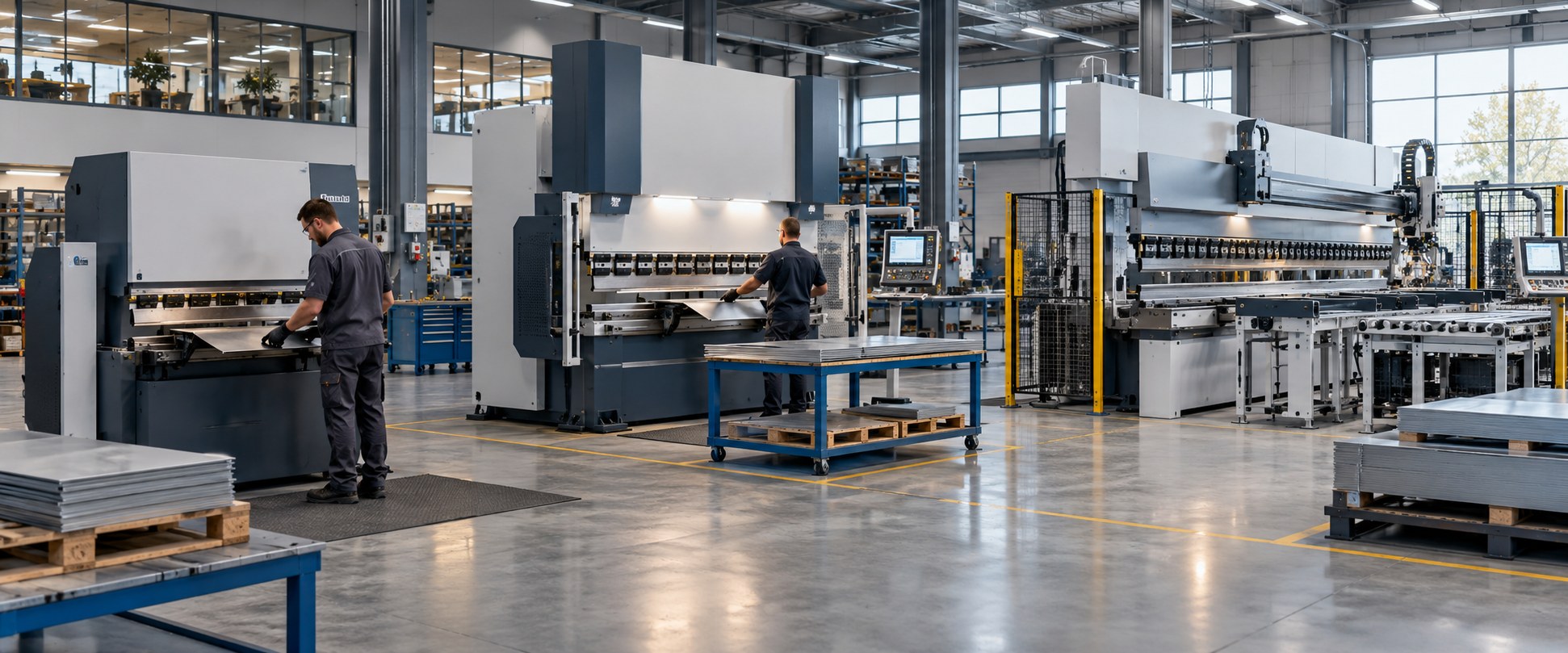
When folding equipment is compared, the distinction between single-fold and forward/reverse folding is easy to overlook. In production, it affects the bend sequence, workpiece handling, tool combination and the number of times an operator must reposition the part. The useful question is not which architecture sounds more advanced, but which one fits the factory’s actual part mix.
BOGONG’s folding range presents three approaches. BGPD uses servo blade splicing, BGSK uses full-servo CNC control, and BGTD focuses on automatic blade adjustment, changeover and compensation. Within each family, the “1” configuration is described for single-direction folding and the “2” configuration for forward/reverse folding.
When cabinet panels, appliance panels or boxes mainly fold in one direction, a single-fold arrangement may be sufficient and the process may remain simpler. When one workpiece needs folds in both directions, or turning the part adds handling and alignment risk, a forward/reverse configuration deserves evaluation.
Begin with the drawings. Mark each bend direction, record the smallest inside dimension and changes in panel width, and identify whether a moving foot or spliced blade structure is required. Then compare working range, axes and material boundaries against the quotation. Speed, width and thickness in a catalog are references; final suitability belongs to the selected model and the sample.
Use one single-direction part and one forward/reverse part in the sample trial. Record setup time, tool changes, manual handling, angle and dimensions. This creates evidence for comparing BGPD-1/2, BGSK-1/2 and BGTD-1/2 rather than choosing from a series name.
Start with a count of folding directions
Many sheet-metal factories compare a CNC folder by width and speed without counting how many single-direction and forward/reverse bends each part requires. Mark the order drawings one by one: forward, reverse, continuous box sequences, smallest inside dimensions and the locations that need a moving foot. This shows whether a single-fold model is sufficient or whether forward/reverse folding could reduce turning and repositioning.
Each family addresses a different architecture
BGPD focuses on servo blade splicing and combinations of different blade widths. BGSK uses full-servo CNC control. BGTD emphasizes automatic blade adjustment, changeover and compensation. The “1” and “2” configurations describe the folding direction arrangement; they are not a promise that one family is always faster or more accurate than another.
Give changeover records to the supplier
The sample should include a single-fold box and a complex panel requiring forward/reverse folding. Record clamping, tool change, program call-up, angle, dimensions and manual handling. BOGONG can use these records to discuss BGPD, BGSK and BGTD sheet-metal automation and a configuration-based FOB quotation. Speed, axes and thickness still need confirmation for the exact model.
Move the reader from the guide to the product range
A reader searching for a CNC folder or forward/reverse folding machine may not have selected a model. First help them make the process decision, then use drawings, material and samples to guide the inquiry to the BOGONG machine range.
Questions about single-fold and forward/reverse folding
How should I compare automatic blade-splicing folders?
List single-direction bends, forward/reverse bends, smallest inside dimensions, changeovers and manual turning for the representative drawings. Compare BGPD, BGSK and BGTD using that table rather than the series name alone.
How do I choose a single-fold folder?
If most products need folds in one direction, a single-fold configuration may be enough. If a box requires both directions or turning affects alignment, compare the “2” configurations. BOGONG can discuss the BGPD, BGSK and BGTD arrangements using the cabinet drawings, material and production mix.
Prepare a folding-architecture comparison
Send two representative part drawings, bend directions, material thickness and panel width to BOGONG for a folding-architecture comparison and configuration discussion.
Need a machine recommendation?
Send your workpiece drawings, material type, burr condition and target surface finish. We will suggest the right sanding machine and give you an FOB price range.