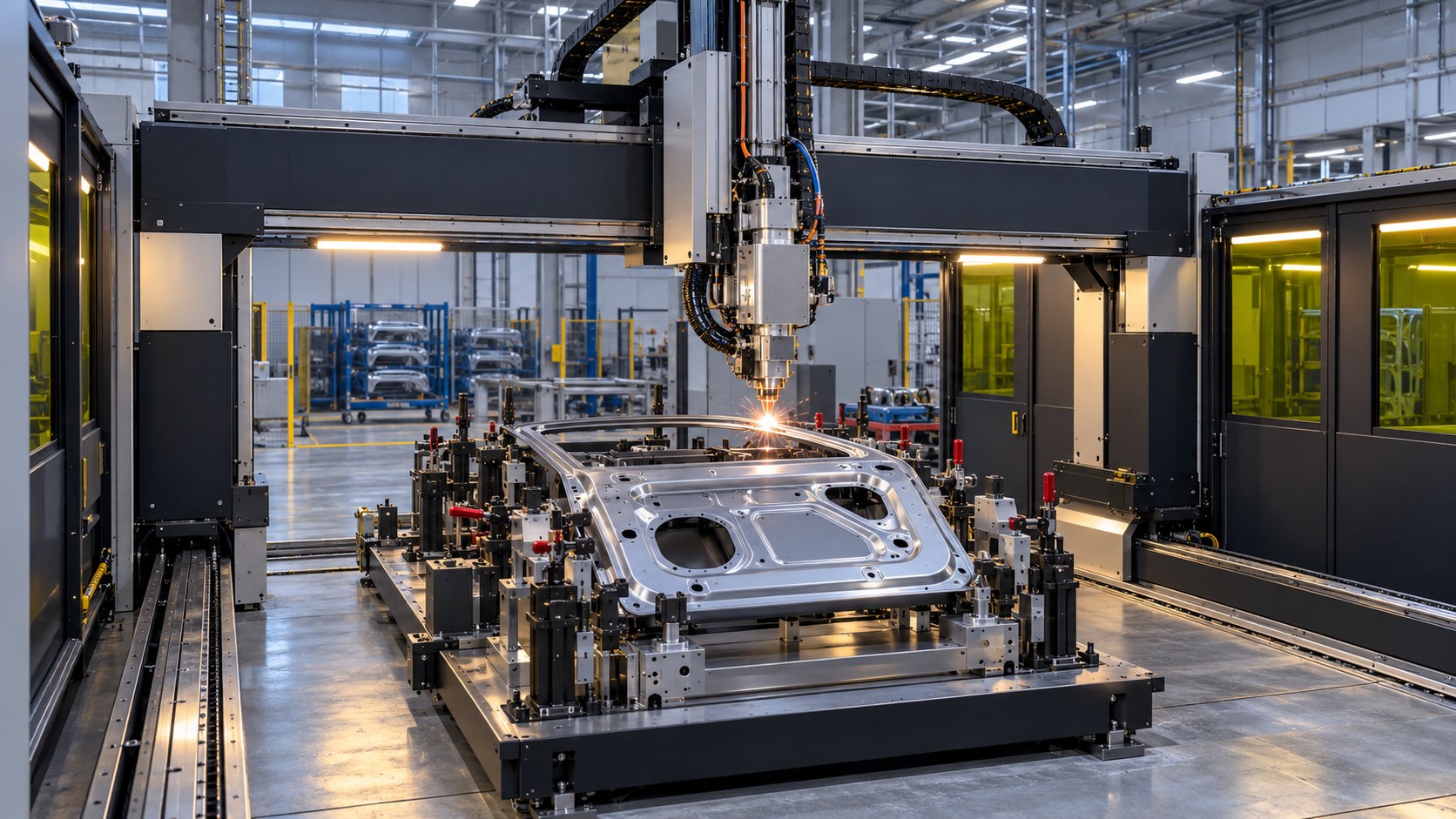
Automated welding is most useful when it is planned from a defined part, fixture and motion path. For sheet-metal, door and window, tube and other repeatable parts, a gantry laser welding system moves the welding head along a controlled path while the fixture holds the workpiece in a known position.
BOGONG’s gantry-type fully automated laser welding system combines a fiber laser source, servo control, ball-screw modules, CCD observation, welding software and a cooling system. The product information describes straight-line, arc and custom-path welding for production work that needs repeatable movement and stable positioning.
Start an automation project with a weld map: seam length, path shape, start and end points, part tolerances and the number of product variants. Then define how the fixture locates the workpiece and how operators will load, unload, select programs and verify the part. A stable motion path cannot compensate for a workpiece that moves in the fixture.
Catalog references include BG-F1500, BG-F2000, BG-F3000 and BG-F6000-LM configurations. Final selection should be demonstrated on samples, including penetration, appearance, thermal deformation, cycle time and changeover. Where product variety is high, program management and fixture changes need the same attention as the welding source.
The practical value of gantry automation is the conversion of manual steps into a recorded route with defined positioning, movement, welding and inspection points. This can help a factory build a more consistent production standard while retaining the ability to design tooling for different parts.
Stable positioning is the foundation of automated welding
A gantry-type fully automated laser welding system is suitable for a repeatable part and a defined path, but the quality of automation begins with the fixture. Define the datum surfaces, clamping positions, loading direction and part variants before writing the program. For doors, windows, sheet-metal frames, tubes and automotive parts, put the parts most likely to deform or shift into the sample trial instead of testing only ideal pieces.
Review servo motion, CCD and software as one workflow
Servo control determines the movement path, CCD observation helps the operator confirm position, and the welding software stores and calls programs. These elements need to be designed together with loading, first-piece inspection and abnormal-condition handling. Ask how different programs are managed, how fixtures are changed, and how an incorrectly loaded part is paused and recovered.
Record process boundaries with samples
Test a straight line, an arc and a custom path. Record weld appearance, penetration, thermal deformation, cycle time and changeover time. BOGONG can discuss a gantry laser welding layout and a factory-direct FOB quotation using drawings, fixtures and the target output. The final power and configuration must be stated in the project documents.
Questions about comparing automated welding suppliers
How should I compare fully automated laser welding manufacturers?
Ask each supplier to explain the fixture, program handling, CCD observation, loading and unloading and recovery from an abnormal condition. For doors, sheet-metal frames and repeated seams, the sample should include straight lines, arcs and more than one clamping condition. This makes the comparison about the complete work cell rather than a laser-source specification alone.
How can a sheet-metal factory set an investment boundary?
Count product variants, seam length, manual handling steps and changeover frequency. Then decide whether a servo laser welding system is justified for the current route. BOGONG can discuss the automation plan and provide a factory-direct laser welding equipment quotation based on the target output, drawings and fixture proposal.
Discuss a gantry welding layout
Review the BOGONG Gantry-Type Fully Automated Laser Welding System. Send seam drawings, part variants, fixture information and target output for a layout discussion and sample-testing plan.
Need a machine recommendation?
Send your workpiece drawings, material type, burr condition and target surface finish. We will suggest the right sanding machine and give you an FOB price range.