At a glance
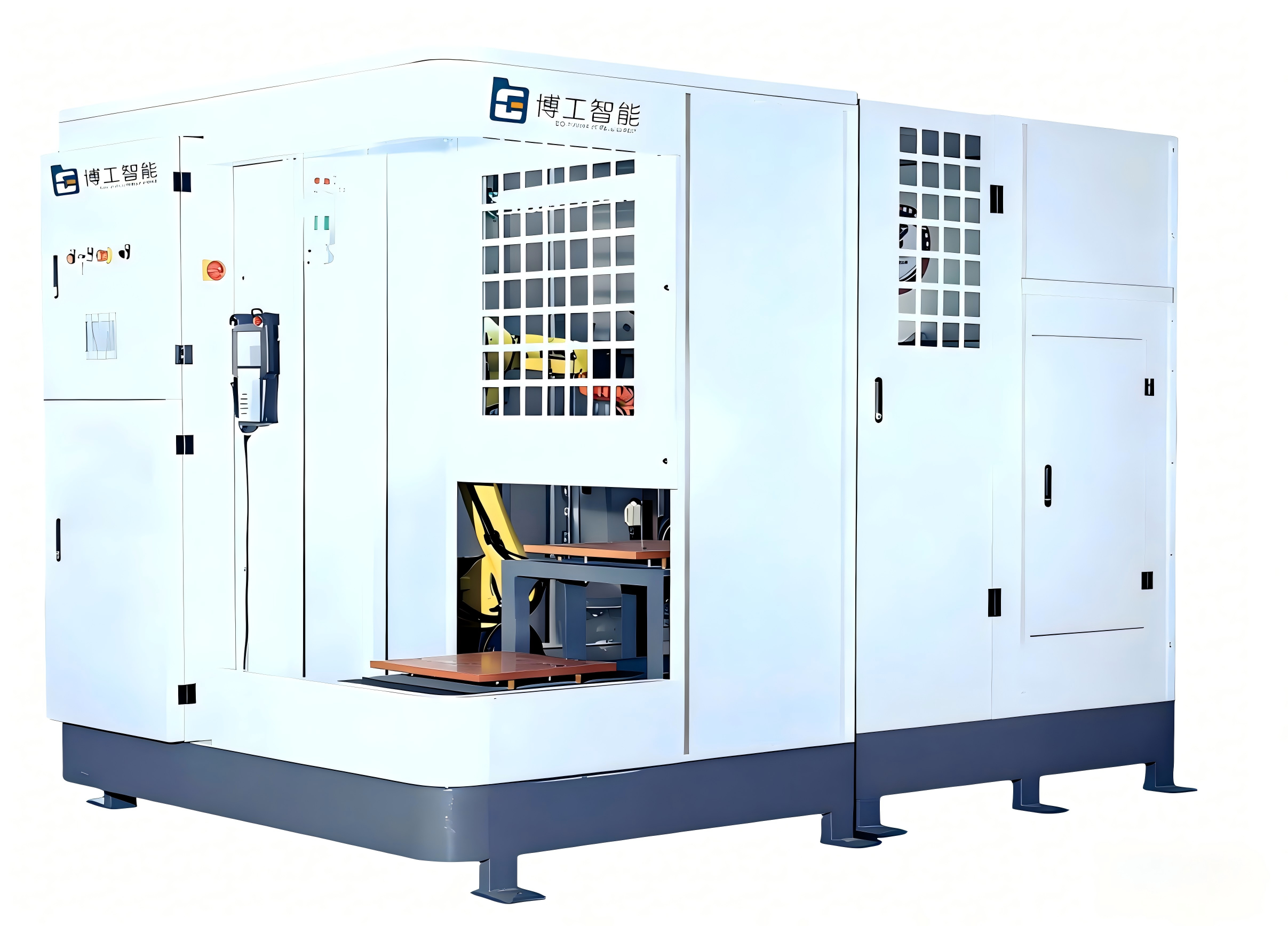
BOGONG’s robotic grinding and deburring center combines robot motion, abrasive tools and fixtures for suitable welded, formed or irregular parts. Its published configuration options include 2D inspection and 3D positioning. Their usefulness must be demonstrated on the actual part, defect variation and required finish.
Extending finishing beyond flat blanks
Some parts cannot be processed as flat workpieces on a feed-through belt. BOGONG’s robotic grinding and deburring center addresses another group of applications, including welded frames, formed parts and sheet metal assemblies. The published product describes a combination of robot movement, sanding tools, fixtures and optional vision. This is an application-engineering discussion: the part’s shape and defect locations determine whether a practical tool path exists.
Fixture and tool access come first
The fixture must locate the workpiece repeatably while leaving the required grinding zones accessible. Tool approach, collision clearance and the effect of contact force should be reviewed together. A narrow corner may be reachable by one tool and inaccessible to another. Start with the largest weld bead or most variable defect that normal production produces. If those conditions cannot be finished without damaging nearby material, improving the upstream process may be necessary before automation.
Give optional vision a specific job
BOGONG’s page distinguishes 2D surface inspection and 3D workpiece positioning as possible modules. These should be tied to defined tasks: locating a part, checking a surface region or supporting a path adjustment. Ask what feature the camera detects, how it handles reflections and what happens when detection fails. A vision module should not be described as automatically solving weld variation or proving an unseen surface condition. Demonstrate the function with representative parts and realistic surface changes.
Manage abrasive wear and the finished geometry
Grinding changes as abrasives wear and incoming welds vary. An acceptance plan should include tooling references, replacement criteria and checks against excessive removal. Where the drawing controls wall thickness or weld geometry, the finished shape matters as much as appearance. Add extraction, guarding and recovery procedures to the cell review. A repeatability demonstration should cover loading, processing and inspection over several parts, including a controlled response to an out-of-tolerance workpiece.
Applications on the shop floor
Repeated welded equipment frames
Evaluate consistent weld locations and fixture references before programming the main paths.
Formed parts with accessible irregular edges
Check reach and tool access around the actual geometry rather than relying on a flat coupon.
Surface inspection after grinding
Define the defect to be detected and test the proposed 2D inspection under realistic surface and lighting conditions.
What to check
| Fixture | Location, stiffness and accessible zones |
|---|---|
| Abrasive tool | Contact shape and wear management |
| Vision option | Defined detection task and failure response |
| Acceptance | Finish and allowable material removal |
Application questions
Is vision included in every BOGONG grinding center?
The product page describes optional vision functions. Confirm the cameras, software and supported task in the project quotation.
Does a robot eliminate all manual finishing?
Not necessarily. Loading, inspection and inaccessible features may still need other operations. Define the actual scope before comparing labor requirements.
Why does weld consistency matter?
Abrasive contact must remove the intended defect without excessive material loss. Large variations make this harder to control.
What is needed for feasibility review?
Provide drawings or models, several real parts, defect photographs, the finish requirement and any limits on wall thickness or weld removal.
Product information
Send BOGONG a marked drawing showing the grinding zones, together with samples covering normal defect variation. Discuss your workpiece
Need a machine recommendation?
Send your workpiece drawings, material type, burr condition and target surface finish. We will suggest the right sanding machine and give you an FOB price range.