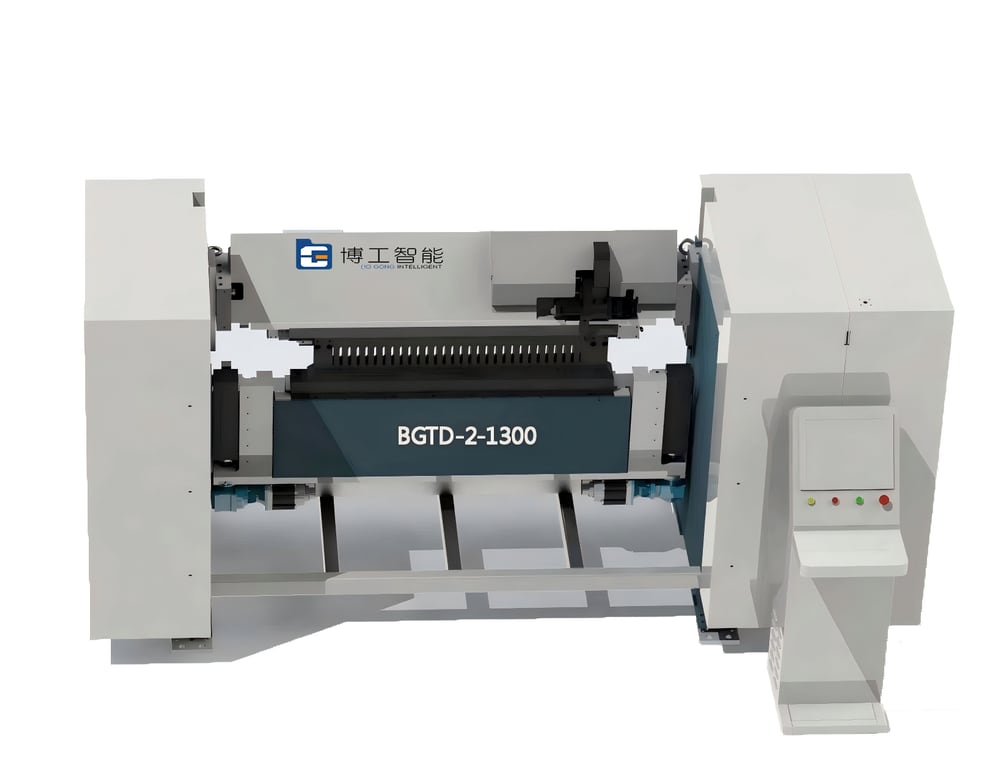
Overview
The BGTD Series Automatic Adjustable Blade CNC Folding Machine is a programmable sheet-metal forming center that combines CNC angle control with automatic blade adjustment. Unlike conventional press brakes that require manual tool changes and shim setups, the BGTD system stores recipes in memory, positions blades electronically, and compensates for tool wear—all without operator intervention between jobs.
Available in 1300 mm and 1600 mm working widths (models BGTD-2-1300 and BGTD-2-1600), this machine is engineered for fabrication shops that run mixed batches of boxes, panels, and brackets in stainless steel, aluminum, and cold-rolled sheet. Every unit is CE-certified, built at our Qingdao factory, and available factory-direct with MOQ of one set.
How It Works
The operator selects a bending program from the touchscreen control or recalls a saved recipe by part number. The CNC controller moves the upper and lower blade beams to the programmed positions, adjusts blade gap automatically for material thickness, and sets back-gauge stops to the correct flange length. The operator places the sheet, presses the foot pedal, and the beam descends to form the angle.
Because blade positioning is servo-driven rather than hand-cranked, repeat accuracy is ±0.1° and positioning time between bends is under 3 seconds. Complex parts with multiple bends—such as four-sided enclosures or drip trays—are produced without stopping to change tools or measure angles.
Key Advantages
1. Automatic Blade Adjustment
Traditional folding machines require the operator to loosen bolts, move blades by hand, and shim to achieve the right gap. The BGTD’s CNC servo system positions blades automatically based on material thickness and bend angle. Setup time drops from 15 minutes to under 60 seconds, dramatically improving machine utilization in high-mix environments.
2. Tool Compensation and Wear Monitoring
As blades wear, bend angles drift. The BGTD control measures actual bend angle via a sensor feedback loop and automatically compensates by adjusting beam depth. This self-correcting feature maintains first-off quality throughout the shift, reducing scrap and inspection overhead.
3. Compact Footprint, High Output
Despite its CNC sophistication, the BGTD series occupies roughly the same floor space as a manual folding machine. You gain automation without losing workshop real estate. The machine can be installed against a wall or in line with a laser cutter and sanding machine for continuous flow production.
4. Wide Material and Thickness Range
Standard blades handle 0.5–2.5 mm stainless steel, 0.5–3 mm aluminum, and 0.5–2 mm cold-rolled sheet. Optional high-strength blade sets extend capacity to 4 mm mild steel. Quick-release blade clamps allow changeover for special profiles—hemming, radiusing, or offset bends—in under 5 minutes.
5. Intuitive Touchscreen Control
The 10-inch color touchscreen runs a custom Bogong interface available in English, Spanish, and Russian. Programs can be created graphically by drawing the profile, imported from DXF files, or entered numerically. A production log records cycle count, setup time, and operator ID for job costing and traceability.
6. Low Operating Cost
The machine uses standard ISO-compliant blades available from multiple suppliers worldwide. There are no proprietary tool contracts, no annual software subscriptions, and no cloud connectivity fees. You own the machine outright and control your own tooling budget.
Typical Applications
- Electrical enclosures and switchgear – Form multi-bend boxes, doors, and mounting plates with consistent flange lengths and square corners.
- HVAC ductwork and fittings – Produce rectangular ducts, transitions, and plenums from galvanized or aluminum sheet.
- Architectural trim and flashings – Bend stainless steel coping, capping, and fascia profiles for building exteriors.
- Food-service equipment – Form countertops, sinks, and shelving from 304 stainless steel with clean radiused bends.
- Prototyping and job-shop work – Switch between one-off custom parts and small-batch production without lengthy setups.
Optional Configurations
| Option | Description | When to Choose |
|---|---|---|
| Back-gauge X-R axis | Motorized back gauge with height and lateral positioning | Complex parts with asymmetric flanges or multiple step bends |
| Hemming tool set | Flat-tenoning blades for 180° edge folds | Door panels, drawer fronts, and sealed-edge products |
| Radiusing blade set | Radius inserts for large bend radii | Architectural stainless or food equipment with rounded edges |
| Sheet support arms | Pneumatic or manual side supports | Large sheets that sag during manual positioning |
| Angle measurement sensor | Real-time bend-angle feedback loop | Tight-tolerance aerospace or medical components |
Maintenance & Support
Daily maintenance is limited to blade cleaning, lubrication of the beam guide rails, and checking hydraulic or pneumatic pressure if fitted. The ball-screw and linear-guide lubrication system is automatic on CNC servo models. Blade sharpening is performed off-machine with a standard surface grinder or sent to a local tooling service.
We supply electrical schematics, a spare parts list with exploded views, and an English maintenance manual with every machine. Remote support is available via WhatsApp video call for control parameter adjustments or alarm diagnosis. For major mechanical issues, we can dispatch a technician to most Asian and Middle Eastern countries within 72 hours.
Frequently Asked Questions
What is the difference between the BGTD and a press brake?
A press brake uses a punch-and-die set to create V-bends. A folding machine clamps the sheet and swings the beam to form the angle. Folding is gentler on pre-finished surfaces (mirror, hairline, coated) because the tool does not slide across the face. It is also faster for boxes and pans because you can form four sides without changing tooling orientation.
Can the BGTD run unattended?
The machine requires an operator to load, position, and remove sheets. However, once a program is running, all angle, depth, and back-gauge adjustments are automatic. With an automatic sheet feeder (third-party integration), semi-automatic production is possible for long runs of identical parts.
What training do you provide?
We include a two-day on-site or remote training package covering program creation, blade changeover, maintenance routines, and safety procedures. Most operators with basic sheet-metal experience are proficient after the first day.